

The Easiest Way to Get Inspired
No tricks – Miriam Huxley reflects on where to find inspiration


The Suffering Creative
I have forever loved the idea of hiding myself away in an attic and writing pages and pages of the most poignant work. Then, like a butterfly emerging from a cocoon (or probably something more vitamin-D deprived), I would enter society and thrill and delight them with my astounding prose. I would present the world with The Next Great Canadian Novel (or maybe Canadian/Scottish novel) and win all the literary prizes and immediately earn myself a place The Canon.
There are a few (just a few) problems with this idea: the first and most important being that shutting yourself away in an attic means closing the door on inspiration because we don’t write in vacuums. And I don’t know about you, but I rarely find myself being visited by The Muse these days. Instead of bolts of inspiration, my writing is built on hard work, tears, and lots of blank pages.
So, if you’re not locking yourself up in a literal (or metaphorical, reader’s choice) attic and waiting for The Muse, where can you go for inspiration?
The Flâneuse
I recently read a post on Substack that celebrated the revolutionary idea of the flâneur – a term that was coined by Charles Baudelaire in his 1863 essay The Painter of Modern Life. Not so revolutionary. If you’re unfamiliar with the term, I think you can sum up a flâneur by saying that he’s someone with time and money, and that time and money gives him the privilege of being able to notice things others don’t. Imagine a snooty man gadding about town with top hat and cane. Probably sneering at people.
Not the most relatable – bear with me.
Reading about somebody (re)discovering the term flâneur reminded me that there was a period in my creative practice when I might have called myself a flâneuse (now imagine a lady in a top hat).
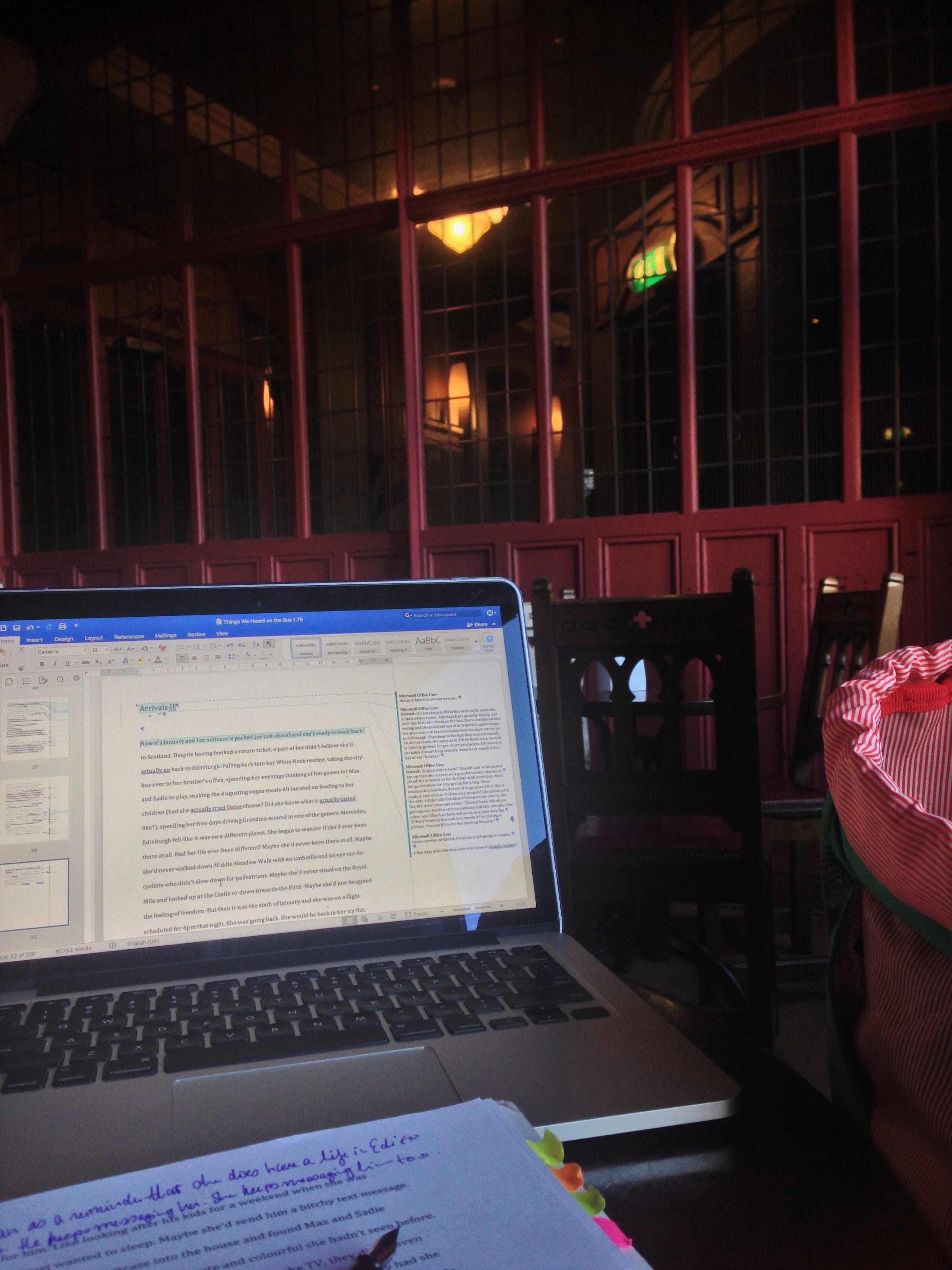
Back when I was working on my MFA, I stumbled (pardon the pun) upon the Walking Methodology, which has many definitions, but I summed up as ‘walking to experience, to learn, and to gain new understanding of the world around us’. In the context of my project (a novel about a young man who (partly) processes the grief surrounding the death of his brother by walking around Edinburgh), this meant that I would literally just go on walks, for about an hour or so, before finding a place to sit and do my work. Imagine my joy at discovering that I could actually include walking as part of my methodology!!! But, as I wrote in my MFA dissertation, ‘the point was to slow down and take in the city around me. I began noticing different things, sounds, sights,’ and when I noticed these new things, I thought about how the characters in my novel would understand them. Through walking, I was ‘creating an experience of the city, by writing I was manifesting that experience as something tangible (i.e., a novel) someone else could participate in.’
Calling myself a flâneuse was a way of romanticising the academic work I was doing (which I didn’t love), and somehow that all fed into what I wrote in my novel. I’d like to think that those walks, and writing about those walks, helped to bring the novel to life.
You don’t have to call yourself a flâneur
or a flâneuse, or even learn about the Walking Methodology. What I’m getting at here is that we don’t actually have to look that hard for inspiration. It is, quite frankly, all around us. We just have to give ourselves the space and time to notice. I was recently moderating an event for
(one of my day jobs) with the poet John Glenday. He said that poets (and writers more generally) need to ‘practice openness’, ‘slow looking’, and give those moments our ‘absorptive attention’.This is, I’d argue, exactly what a flâneur is doing, and what the Walking Methodology prescribes. It’s about slowing down, taking things in, and noticing.
I’m also reminded of a favourite prompt from Natalie Goldberg’s Writing Down the Bones, which I wrote about in my 30 Day Writing Challenge post (linked below in case you want to return to it!). The prompt suggests starting with the opening line ‘I am looking at’, and you can repeat that as many times as you’d like. In my post, I wrote about how looking at things in my kitchen evolved from describing objects to speculating about why they might there, and what they might say about me (or a character). You could alter the prompt by choosing to write ‘I am hearing/noticing/smelling/feeling’ or any other combination. And the great thing about the prompt is that it’s portable – you can return to it when you’re out on your walk, or sitting in a cafe feeling uninspired.
Suffer no more
I say blithely, knowing that sometimes writing does feel like suffering. But what I’m saying here is that you don’t have to suffer in wait. Get out into the world, in whatever way you can. Maybe bring a notebook with you and stop at a park bench. Try the ‘I am looking at’ prompt and write down all the things you’re looking at. And then return to each item and really look at them. Pay attention to the small details.
If you’re working on a project, be it a poem, short story, novel, whatever, think about how your subject/characters might notice those same things and make some notes. From there, you might write a little about why your character is out on a walk noticing these things. What are they feeling in the moment?
You might want to keep a special notebook for this writing – I highly recommend this because I will take any opportunity to either use one of the many lovely notebooks I have sitting on my desk, or, even better, go and buy a new one.
This kind of writing may never make it into the final draft of the poem, short story, or novel you’re working on, but it’s part of the process. And even better than that, I think this kind of writing is the fun part of writing.
And if nothing else, you’re putting pen to paper, you’re doing the work. So, next time you feel stuck and worry that you have nothing to write about, take a notebook and go for a walk, or find out a window to look out. You don’t need thunderbolts from the divine, I promise.
If you need further inspiration, catch up on our 30 Day Writing Challenge here!

Miriam Huxley is a freelance project manager, editor, writer, and sometimes creative writing teacher with a PhD and a lot of plants. She regularly writes here, and over on The Infinite To Be Read.
Help to support Hillfire writers like Miriam by donating to our fundraising campaign.
Time to go for a walk! :D
Love this and love being a flaneur - must get a gold-tipped cane and flounce around more! Do you reckon flaneuring is mostly a city thing or can you do it in fields too? Good day to you cows, sort of thing?